Quick Answer
A Flock camera is a camera system from Flock Safety that is primarily designed to capture and analyze information about passing vehicles. The company’s most widely discussed cameras are automated license plate readers (ALPRs) that photograph vehicles and convert information from those images into searchable data.
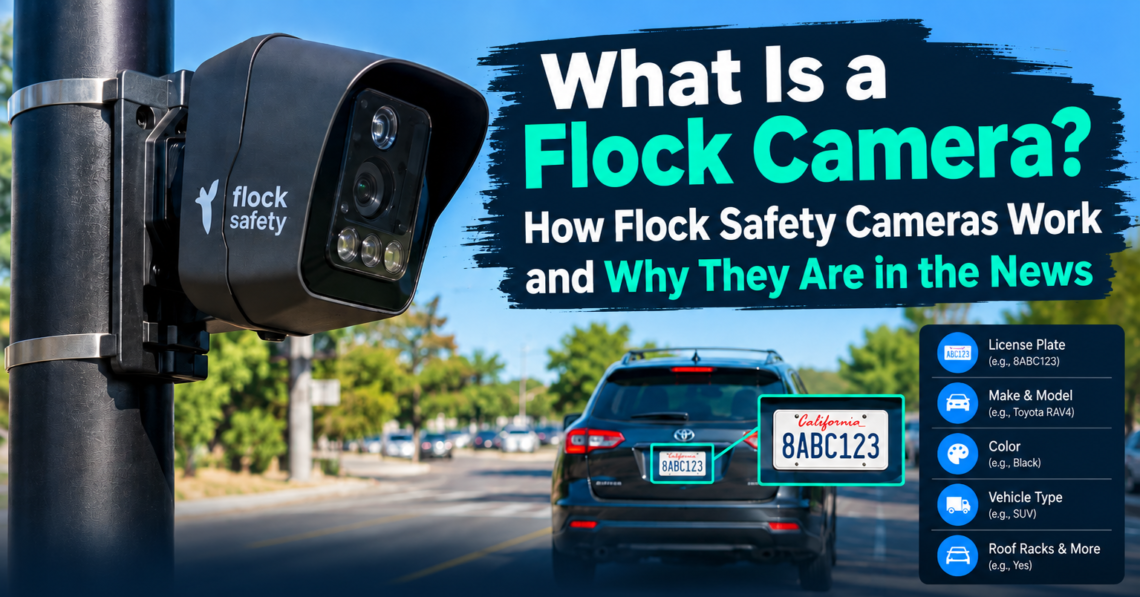
A Flock Safety camera can capture a vehicle image, license plate information, vehicle characteristics, the date, time and camera location. Flock says its LPR system does not use facial recognition.
The technology received renewed attention in September 2026 after a joint WIRED and 404 Media investigation examined data recovered from a physically removed Flock camera. The investigation found about 1.6 million images involving roughly 50,200 vehicles across recovered periods covering about 21 days. The recovered device also contained 27,321 short video clips . It also revealed technical details about how the camera captures and processes images.
Flock’s current policy says LPR data is hard-deleted from the cloud after seven days by default, although the retention period can differ under a customer’s law, policy or agreement
What Is a Flock Camera?
A Flock camera is part of Flock Safety’s connected public-safety technology platform.
The company offers several types of security and camera products, but the devices most commonly referred to as Flock cameras are its automated license plate readers.
An ALPR combines a camera with software that processes images of passing vehicles and turns relevant information into computer-readable data.
Flock’s current LPR policy defines the collected information as including:
- License plate image
- Vehicle image
- Vehicle characteristics
- License plate number
- License plate state
- Date
- Time
- Camera location
Flock says its technology is used by law enforcement agencies, communities, schools, businesses and other organizations. Flock says its technology is used by more than 5,000 law enforcement agencies and 6,000 communities
That scale is one reason the technology has become a major topic in discussions about surveillance, data sharing and public safety.
How Does a Flock Camera Work?
The basic process is fairly straightforward:
A vehicle passes the camera → the camera captures images → software processes the images → vehicle information is created → the record becomes searchable to authorized users.
Here’s what happens in more detail.
1. The camera detects a passing vehicle
Flock’s LPR cameras are designed to detect vehicles as they enter the camera’s field of view.
The devices are designed for roadside deployment and can operate using solar power and cellular connectivity, which means they do not necessarily require conventional electrical wiring or a fixed internet connection. Flock describes its LPR hardware as solar-powered and LTE-connected.
2. It captures a series of images
The camera captures images as the vehicle passes.
This process is more complex than taking one photograph of a license plate.
WIRED’s September 2026 investigation found that a typical passing vehicle generated around 28 images on the recovered camera. Some vehicles generated more than 100 images.
The camera used different exposures to capture the license plate and wider portions of the scene.
It then selected and cropped useful frames before sending information to Flock’s servers.
The number of images can vary depending on the vehicle, traffic conditions and camera configuration. The figures from WIRED came from one recovered device and should not be treated as a standard output for every Flock camera.
3. The data is transmitted to the cloud
Flock says LPR data is stored briefly on the camera before being transferred to its cloud infrastructure. Its policy describes encryption during transmission and cloud storage.
Flock’s policy says LPR data is stored briefly on the camera before being transferred to the cloud.
4. Software analyzes the vehicle
Flock’s software can process information such as the license plate and vehicle characteristics.
Flock says its machine-learning technology can identify characteristics including vehicle type, color, make and other visible features.
The WIRED investigation found that the recovered camera selected and cropped useful images, while some more complex processing appeared to occur on Flock’s servers.
5. Authorized users can search the records
The resulting information can be searched through Flock’s platform.
Depending on the available data and permissions, users can search by information such as:
- License plate
- Vehicle color
- Vehicle make
- Vehicle type
- Time
- Location
- Other vehicle characteristics
Flock says customer access is controlled through permissions and that searches are recorded for auditing.
What Information Do Flock Cameras Collect?
A Flock license plate reader collects more than a plate number.
According to Flock’s current LPR policy, the system can collect the following:
| Information | What it means |
| License plate image | Photograph of the plate |
| Vehicle image | Image of the passing vehicle |
| Plate number | Computer-readable plate information |
| Plate state | State associated with the plate |
| Vehicle characteristics | Details such as color and make |
| Date and time | When the vehicle was detected |
| Camera location | Where the detection occurred |
Flock also says its Vehicle Fingerprint technology can help users search for vehicles using characteristics other than the license plate.
These can include features such as vehicle type, color, roof racks and other visible characteristics.
This can be useful when a license plate is difficult to read or unavailable.
What Does a Flock Camera Record Beyond the License Plate?
This is one of the more important questions raised by the recent investigation.
Flock describes its LPR technology as a vehicle-focused system. However, WIRED’s analysis of data recovered from one camera found that the device’s software included models capable of detecting people and other objects in images.
The researchers tested the person-detection models against footage recovered from the camera.
WIRED found that the camera’s person-detection models detected people in 11 of the 27,321 short video clips. All 11 detections involved motorcyclists. The clips were one to two seconds long and had no audio. The people detected in those clips were riding motorcycles.
This does not mean Flock’s LPR system identifies people through facial recognition.
Flock says its LPR cameras do not use facial recognition, and the WIRED investigation did not establish that the recovered camera was using facial recognition.
The distinction is important:
Detecting that a person appears in an image is not the same as identifying who that person is.
Are Flock Cameras License Plate Readers?
Yes.
The cameras at the center of the current discussion are automated license plate readers, commonly called ALPRs or LPRs.
An ALPR combines cameras and software to convert vehicle and license plate images into searchable data.
Flock’s own policy defines an LPR system as automated high-speed cameras used with data processing to convert vehicle and license plate images into computer-readable information.
The difference between a basic camera and an ALPR system is therefore the software layer.
A traditional security camera may record video that someone later reviews manually.
A Flock LPR system is designed to turn vehicle detections into structured, searchable records.
Why Are Flock Cameras in the News?
There are two separate developments behind the current attention.
The first is a September 2026 security investigation involving a physically removed camera.
The second is the continuing debate over how Flock data is accessed, shared and used by law enforcement agencies.
These issues should be considered separately.
The September 2026 Flock Camera Investigation
On September 16, 2026, WIRED and 404 Media reported on data recovered from a Flock camera that had been physically removed from a roadway.
Researchers analyzed files from the device to understand how Flock’s hardware and software work.
What did the recovered data show?
WIRED reported that the recovered device contained data covering approximately 21 days of activity across several periods.
During those periods, researchers identified approximately:
- 1.6 million images
- 50,200 vehicles
- 27,321 short video clips
The device recorded about 3,300 vehicles on a typical day, with a peak of approximately 4,454 vehicles during one day in the recovered logs.
These numbers came from one camera.
They do not represent the average amount of data generated by every Flock camera.
The investigation also noted that the camera was likely operating outside the recovered periods, but older logs had been overwritten or were no longer recoverable.
What did the investigation reveal about the camera’s software?
The researchers found that the camera ran multiple Flock-developed applications.
These applications handled functions including:
- Motion detection
- Image capture
- Object classification
- Data uploads
- Remote software updates
The camera’s software could also detect people in images.
The investigation therefore offered a more detailed look at what happens inside an LPR device than is normally visible from the outside.
Did the Flock Camera Incident Compromise the Company’s Entire Network?
There is an important distinction here.
The September investigation involved physical access to one camera and the data stored on that device.
It did not establish that attackers had gained access to Flock’s entire cloud database.
WIRED reported that hackers recovered an encryption key stored on the camera, which allowed access to much of the media stored on that device. Flock disputed the circumstances and said unauthorized removal and tampering with its cameras is illegal.
So the safest description is:
The incident demonstrated a physical compromise of one camera and its locally stored data; it did not establish that Flock’s entire cloud network had been breached.
That distinction matters when discussing Flock camera security.
How Long Does Flock Camera Data Stay?
This is one area where the original information commonly found online can be outdated.
Flock’s current LPR policy, updated June 30, 2026, says LPR data is hard deleted on a rolling seven-day basis by default. The company says the retention period can be changed when a different schedule is required by a customer’s law or policy.
Flock’s current Evidence Policy states that its standard retention period is seven calendar days from the date of capture, unless a customer agreement specifies otherwise. It says customers can request longer retention in certain circumstances.
So the answer to “how long does Flock camera data stay?” is:
Seven days is Flock’s current default for LPR data, but the actual retention period can vary.
The approximately 21 days of material found by WIRED should not be interpreted as Flock’s standard cloud retention period. That material was recovered from the physical storage and logs of one camera.
Who Can Access Flock Camera Data?
Flock says customer organizations control access to their LPR data.
Its current policy states that customers own their LPR data and decide whether to share it with other customers, subject to applicable laws and policies.
Flock’s Trust Center says access is restricted to approved users with role-based permissions and that every search is recorded and reviewable.
That does not mean a camera installed by one agency is necessarily searchable only by that agency.
Flock’s policies indicate that customers can choose to share LPR data with other authorized customers, subject to applicable permissions, agreements and law.
The extent of that access therefore depends on the participating organizations, their agreements, permissions and applicable law.
What Is Flock Camera Privacy?
The main privacy question is not simply whether a camera can read a license plate.
It is also about what information is retained, who can search it, how it can be shared and how long it remains available.
Data collection
Flock cameras collect vehicle-related information including plates, vehicle characteristics, timestamps and locations.
Data sharing
Flock says customers control whether their LPR data is shared with other customers.
Search access
Flock says authorized searches are logged and reviewable.
Data retention
Flock’s default LPR retention period is seven days, although different legal or contractual requirements can apply.
These are the technical and policy controls Flock describes. Their effectiveness in a particular deployment can depend on how a customer configures and uses the system.
Documented Concerns About Flock Camera Use
There have also been documented cases involving alleged misuse of Flock’s system.
For example, authorities in Kentucky reportedly arrested a police officer in August 2026 after alleging that he conducted 2,048 searches involving two vehicles associated with his former partner. Reports said 241 of those searches occurred while a protection order was in place.
Flock subsequently promoted an AI-based auditing tool designed to identify unusual patterns of system use.
This type of case illustrates why access controls and audit logs matter for systems containing location-linked vehicle data.
It does not, by itself, establish that all Flock users misuse the system.
Why Are Flock Cameras Facing Broader Scrutiny?
Flock’s technology has also become the subject of broader local and federal debate.
Research from the anti-surveillance group Secure Justice, reported by Ars Technica, counted 214 cities and counties that had ended Flock contracts since 2021, with 90 ending their relationships in August 2026 alone. The figures are from an advocacy group’s tracking and are not a government count. Flock told Ars that new city partnerships in 2026 were outpacing nonrenewals by approximately 10 to 1.
This provides two different pieces of information:
- Some communities are ending or reconsidering Flock contracts.
- Flock says its overall number of new partnerships continues to exceed nonrenewals.
Both are relevant to understanding the current state of the technology.
Flock Cameras and the September 2026 Senate Hearing
The technology also received federal attention on September 23, 2026.
The Senate Judiciary Subcommittee on Crime and Counterterrorism held a hearing titled “Always Watching: Flock’s Nationwide AI Surveillance Network.” The hearing included witnesses discussing ALPR technology, privacy and oversight.
The hearing is part of the broader discussion around how automated license plate readers should be governed and how organizations should control access to the resulting data.
The existence of the hearing does not itself establish that Flock’s technology violates any particular law. It shows that the technology has become a subject of formal federal oversight and debate.
Flock Camera Security: What Does Flock Say?
Flock says its LPR system uses multiple security measures.
According to the company’s current policies:
- Data is encrypted during transmission.
- Data stored in the cloud is encrypted.
- Customer access uses role-based permissions.
- Searches are recorded.
- LPR data is automatically deleted according to the applicable retention period.
- Flock says it uses safeguards intended to protect cameras against tampering and firmware vulnerabilities.
The September investigation nevertheless showed why physical device security is a separate issue from cloud security.
Researchers were able to recover data from one physically removed camera, including an encryption key that allowed access to stored media.
That finding does not demonstrate that Flock’s cloud encryption was broken.
Instead, it highlights a different security question: how well is sensitive data protected while it is temporarily stored on the physical camera?
Flock Camera vs Traditional Security Camera
Although both are cameras, their primary functions are different.
| Feature | Flock LPR camera | Traditional security camera |
| Primary purpose | Vehicle identification and evidence | General video monitoring |
| License plate reading | Yes | Usually requires separate software |
| Vehicle characteristics | Yes | May require AI or manual review |
| Searchable vehicle records | Yes | Depends on the system |
| Continuous video | Not the primary LPR function | Common |
| Facial recognition | Flock says its LPR cameras do not use it | Depends on the system |
| Cloud processing | Yes | Depends on the system |
| Vehicle searches | Core function | Usually not the primary function |
The important difference is not simply the camera hardware.
It is the combination of camera + machine learning + searchable database + connected access system.
Are Flock Cameras Facial Recognition Cameras?
Flock says no.
Flock says its LPR cameras do not use facial recognition. The system is designed to identify and search vehicles using information such as license plates and vehicle characteristics.
However, the September WIRED investigation found that software on one recovered camera could detect people appearing in images.
Those are different capabilities.
Person detection means software can identify that a human figure appears in an image.
Facial recognition involves using a person’s facial characteristics to identify or match that individual.
The recent investigation did not establish that the Flock camera was using facial recognition.
What Are Flock Cameras Used For?
Flock markets its LPR technology for uses such as investigating:
- Stolen vehicles
- Missing people
- Crime scenes
- Vehicle-related incidents
- Other investigations involving a vehicle
The company says its network can help authorized users find vehicles using plate information and other vehicle characteristics.
For law enforcement, the technology can provide a searchable record of vehicle sightings.
For private communities and organizations, the technology can be used for security and access-related purposes.
The exact use depends on the customer, local policies and applicable law.
Flock Camera Privacy Concerns: What Should You Know?
If you are trying to understand the privacy debate around Flock cameras, four questions matter most:
1. What does the camera capture?
It can collect vehicle images, license plate information, vehicle characteristics and location-linked timestamps.
2. Who can search the information?
Flock says access is limited to authorized users and that searches are logged. Customers can also choose to share LPR data with other customers.
3. How long is the information kept?
Flock’s default LPR retention period is seven days, but different rules can apply depending on law or customer agreements.
4. Can the hardware itself be compromised?
The September 2026 investigation showed that researchers could recover data from one physically removed camera. It did not demonstrate a compromise of Flock’s entire cloud network.
These questions are more useful than treating the technology as either completely safe or completely unsafe.
Frequently Asked Questions
What is a Flock camera?
A Flock camera is a camera system made by Flock Safety. In current news coverage, the term usually refers to the company’s automated license plate reader cameras, which capture vehicle images and create searchable vehicle records.
How does a Flock camera work?
A Flock LPR camera detects passing vehicles, captures a series of images and sends the relevant data to Flock’s cloud system. Software then processes license plate and vehicle characteristics and makes the resulting information searchable to authorized users.
What does a Flock camera record?
It can record a license plate image, vehicle image, vehicle characteristics, license plate number, issuing state, date, time and camera location.
Are Flock cameras license plate readers?
Yes. The Flock cameras most commonly discussed in current reporting are automated license plate readers, or ALPRs.
How long does Flock camera data stay?
Flock’s current LPR policy says data is hard-deleted from the cloud after seven days by default.
The retention period can differ when required by law or under a customer’s agreement.
Do Flock cameras use facial recognition?
Flock says its LPR cameras do not use facial recognition. A recent WIRED investigation found that one recovered camera had software capable of detecting people in images, but it did not establish that the system used facial recognition.
What information do Flock cameras collect?
Flock’s LPR system can collect license plate images, vehicle images, vehicle characteristics, plate numbers, plate states, timestamps and camera locations.
Why are Flock cameras in the news?
A September 2026 WIRED and 404 Media investigation examined data recovered from a physically removed Flock camera. The recovered data included about 1.6 million images involving roughly 50,200 vehicles across approximately 21 days of recovered activity, along with 27,321 short video clips.
Flock cameras have also received scrutiny over data access, alleged misuse and how connected ALPR networks should be governed.
Did the September 2026 incident hack Flock’s entire network?
No. The investigation involved physical access to one camera and data stored on that device. It did not establish that Flock’s entire cloud network had been breached.
Can Flock cameras track a person’s movements?
The cameras record vehicle sightings at specific locations rather than functioning like GPS trackers. However, searchable records from multiple cameras can show where a vehicle was detected at different times. Flock’s platform is designed to allow authorized users to search vehicle records across connected cameras.
Bottom Line
A Flock camera is an automated license plate reader system that combines cameras, machine learning and a searchable database of vehicle information.
It can collect license plate images, vehicle characteristics, timestamps and camera locations. Flock says its LPR system does not use facial recognition, while a recent WIRED investigation found that one recovered camera had software capable of detecting people appearing in its images.
The technology is in the news for two related but distinct reasons: a September 2026 investigation provided a rare look inside the hardware, while separate cases have raised questions about how authorized users access and share vehicle data.
Flock’s current policy says seven days is the default cloud-retention period for LPR data, although the actual period can vary under applicable laws, policies and customer agreements.
For anyone trying to understand the privacy and security debate, the key questions are straightforward: what does the system capture, who can search it, who can access or share the data, how long is it retained, and how well is the physical hardware protected?
Those questions can be answered with documented technical details without reducing the wider debate to a simple “safe” or “unsafe” label.