
Quick Answer
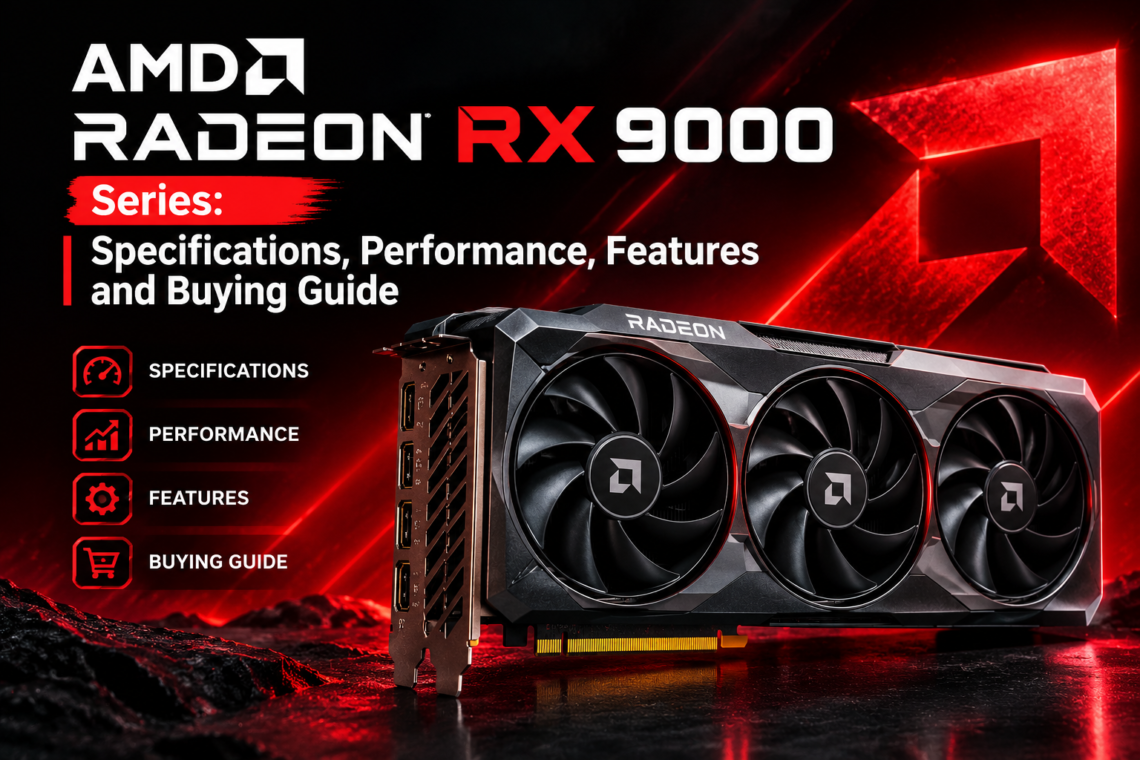
The AMD Radeon RX 9000 series is AMD’s current desktop gaming GPU family based on the RDNA 4 architecture. The lineup includes the Radeon RX 9070 XT, RX 9070, RX 9070 GRE, RX 9060 XT, RX 9060 and RX 9050, including different memory variants for some models.
RDNA 4 brings third-generation ray tracing accelerators and second-generation AI accelerators. AMD also supports newer FSR technologies designed to use machine learning for image reconstruction and performance improvements.
The Radeon RX 9070 XT sits at the top of the current RX 9000 desktop lineup, with 64 compute units and 16GB of GDDR6 memory. The RX 9070 keeps the same 16GB capacity with fewer compute units, while the RX 9070 GRE drops to 12GB and 48 compute units.
For buyers, the choice comes down to more than raw GPU power. Resolution, VRAM, ray tracing, FSR support, power consumption and current pricing all matter.
What Is AMD Radeon RX 9000?
AMD Radeon RX 9000 is a family of AMD Radeon graphics cards built on RDNA 4.
AMD introduced the RX 9070 XT and RX 9070 as the first desktop cards in the generation. The lineup has since expanded to include lower-priced models and the RX 9070 GRE. AMD’s current product pages list eight desktop RX 9000 variants across the RX 9070, RX 9060 and RX 9050 families.
The generation is designed around several key technologies:
- RDNA 4 compute units
- Third-generation ray tracing accelerators
- Second-generation AI accelerators
- GDDR6 graphics memory
- PCIe 5.0
- DisplayPort 2.1a
- HDMI 2.1b
- AMD FSR technologies
- AMD Fluid Motion Frames
- Radeon Anti-Lag
- AMD HYPR-RX
The exact feature set and memory configuration vary by GPU model.
RX 9000 Series: The Lineup at a Glance
| GPU | Compute Units | VRAM | Memory Bus | Ray Accelerators | AI Accelerators |
| Radeon RX 9070 XT | 64 | 16GB GDDR6 | 256-bit | 64 | 128 |
| Radeon RX 9070 | 56 | 16GB GDDR6 | 256-bit | 56 | 112 |
| Radeon RX 9070 GRE | 48 | 12GB GDDR6 | 192-bit | 48 | 96 |
| Radeon RX 9060 XT | 32 | 16GB GDDR6 | 128-bit | 32 | 64 |
| Radeon RX 9060 XT | 32 | 8GB GDDR6 | 128-bit | 32 | 64 |
| Radeon RX 9060 | 28 | 8GB GDDR6 | 128-bit | 28 | 56 |
| Radeon RX 9050 | 16 | 8GB GDDR6 | 128-bit | 16 | 32 |
| Radeon RX 9050 | 16 | 8GB GDDR6 | 128-bit | 16 | 32 |
These specifications come from AMD’s current RX 9000 product listings. AMD also lists different board configurations for some models, so the exact specifications can vary by version.
The Biggest RDNA 4 Changes
RDNA 4 is not simply a clock-speed upgrade.
AMD’s architecture overview identifies three major changes compared with RDNA 3:
- Third-generation ray tracing accelerators
- Second-generation AI accelerators
- A newer generation of Infinity Cache and display technology
RDNA 4 is manufactured using a 4nm process for the RX 9000 desktop family.
1. Improved Ray Tracing
Ray tracing calculates how light interacts with objects in a game. It can create more realistic reflections, shadows and lighting.
The downside is that ray tracing requires significant GPU resources.
RDNA 4 introduces third-generation ray tracing accelerators. AMD says the new architecture delivers a major generational improvement in ray tracing performance compared with previous Radeon generations.
Independent testing also shows that ray tracing performance has improved substantially over RDNA 3. However, Nvidia can still hold an advantage in some ray-traced workloads, so buyers should not assume that every game will perform equally across Radeon and GeForce GPUs.
2. Second-Generation AI Accelerators
One correction is important here.
AI acceleration is not new to Radeon. AMD introduced AI accelerators with RDNA 3. RDNA 4 moves to second-generation AI accelerators with additional support for newer AI compute formats.
The RX 9070 XT has 128 AI accelerators, while the RX 9070 has 112.
These accelerators can help with AI workloads and machine-learning-based graphics features.
What Does FSR 4 Do?
AMD FidelityFX Super Resolution, or FSR, is AMD’s family of image reconstruction and performance technologies.
The newer FSR generation uses machine learning to reconstruct frames from a lower-resolution input. This can help increase frame rates while maintaining image quality.
AMD says its newer machine-learning-based FSR Upscaling is available on Radeon RX 7000 and RX 9000 series graphics cards, while FSR “Redstone” technologies are available on RX 9000 cards and selected RX 7000 cards
This matters because modern GPU performance is no longer determined only by native rendering speed.
A game using FSR, frame generation or other supported technologies can produce a very different result from a game running entirely at native resolution.
Support also depends on the individual game.
Radeon RX 9070 XT: What You Get
The Radeon RX 9070 XT is the highest-performance model in AMD’s current RX 9000 desktop gaming lineup.
Its main specifications include:
- 64 compute units
- 4,096 stream processors
- Up to 2.97GHz boost frequency
- 16GB GDDR6 memory
- 256-bit memory interface
- Up to 640GB/s memory bandwidth
- 64MB Infinity Cache
- 64 ray accelerators
- 128 AI accelerators
- 304W typical board power
- 750W minimum PSU recommendation
AMD lists a $599 launch suggested etail price for the RX 9070 XT.
The card is aimed at high-performance 1440p and 4K gaming.
Independent testing by Tom’s Hardware found strong rasterization performance from the RX 9070 XT and significant generational improvements in ray tracing and AI performance.
Radeon RX 9070: The 16GB Alternative
The Radeon RX 9070 uses the same RDNA 4 architecture but reduces the compute resources.
It has:
- 56 compute units
- 3,584 stream processors
- Up to 2.52GHz boost frequency
- 16GB GDDR6
- 256-bit memory interface
- Up to 640GB/s memory bandwidth
- 64MB Infinity Cache
- 56 ray accelerators
- 112 AI accelerators
- 220W typical board power
- 650W minimum PSU recommendation
AMD lists a $549 launch suggested etail price.
The important point is that the RX 9070 retains the 16GB memory capacity of the XT.
That makes it relevant to gamers who want a high-performance 1440p or 4K-capable card without moving to the higher power and price level of the XT.
Radeon RX 9070 GRE: Where Does It Fit?
The Radeon RX 9070 GRE sits below the RX 9070.
It has:
- 48 compute units
- 3,072 stream processors
- Up to 2.79GHz boost frequency
- 12GB GDDR6
- 192-bit memory interface
- Up to 432GB/s memory bandwidth
- 48MB Infinity Cache
- 48 ray accelerators
- 96 AI accelerators
- 220W typical board power
- 650W minimum PSU recommendation
AMD lists the RX 9070 GRE as part of the RX 9000 family.
It is positioned around 1440p gaming.
Independent testing from Tom’s Hardware found solid rasterization performance but also noted that the 12GB VRAM can become a limitation in some ray-traced workloads at 1440p and above.
That makes the actual price difference between the RX 9070 GRE and RX 9070 important when shopping.
What About the RX 9060 and RX 9050?
The lower end of the RX 9000 family is built for more affordable gaming systems.
Radeon RX 9060 XT
The RX 9060 XT is available with 8GB or 16GB of GDDR6 memory.
Both versions have:
- 32 compute units
- 2,048 stream processors
- 32 ray accelerators
- 64 AI accelerators
- 128-bit memory interface
- 32MB Infinity Cache
The 16GB version has 160W typical board power, while AMD lists 150W for the 8GB model. AMD lists a memory bandwidth of up to 320GB/s for the RX 9060 XT. model. AMD launched the 8GB version at $299 and the 16GB version at $349.
The 16GB model can be particularly relevant for buyers who want more memory headroom without moving into the RX 9070 class.
Radeon RX 9060
The RX 9060 has 28 compute units and 8GB of GDDR6 memory.
AMD lists:
- 28 compute units
- 1,792 stream processors
- 28 ray accelerators
- 56 AI accelerators
- 8GB GDDR6
- 128-bit memory interface
132W typical board power and up to 288GB/s memory bandwidth
It is positioned below the RX 9060 XT.
Radeon RX 9050
The RX 9050 is an entry-level RDNA 4 desktop GPU.
The current AMD specification lists:
- 16 compute units
- 1,024 stream processors
- 8GB GDDR6
- 128-bit memory interface
- 32MB Infinity Cache
- 16 ray accelerators
- 32 AI accelerators
- 92W typical board power
AMD also lists a separate 4GB RX 9050 variant with a 64-bit memory interface and 16MB Infinity Cache.
For a budget gaming PC, the exact price and availability of these lower-end models matter more than their position on the product stack.
Radeon RX 9000 Performance: What Should You Expect?
There is no single Radeon RX 9000 performance number.
Gaming performance changes depending on:
- Game engine
- Resolution
- Graphics settings
- Ray tracing
- Upscaling
- Frame generation
- CPU
- Drivers
- Game optimization
This is why benchmark results should always be read in context.
Tom’s Hardware’s testing of the RX 9070 XT and RX 9070 showed strong rasterization results, while its ray tracing tests produced a different performance picture.
The RX 9070 GRE also demonstrates why model-level testing matters. Its 12GB memory configuration can be adequate for many 1440p workloads, but testing showed limitations in some demanding ray-traced scenarios.
In other words, more compute units do not automatically translate into the same performance increase in every game.
Radeon RX 9070 vs RTX: What Is the Difference?
The Radeon RX 9070 and RX 9070 XT are often compared with Nvidia’s GeForce RTX 5070-class products.
The two companies take different approaches to gaming features.
| Feature | Radeon RX 9070 | Nvidia RTX 5070 |
| GPU architecture | AMD RDNA 4 | Nvidia Blackwell |
| Memory | 16GB GDDR6 | 12GB GDDR7 |
| Ray tracing | Third-generation AMD RT accelerators | Nvidia RT hardware |
| AI hardware | Second-generation AMD AI accelerators | Nvidia Tensor cores |
| Upscaling | AMD FSR | Nvidia DLSS |
| Frame generation | AMD Fluid Motion Frames and supported FSR technologies | Nvidia DLSS technologies |
| Display support | DisplayPort 2.1a, HDMI 2.1b | Varies by model |
The RX 9070 has 16GB of GDDR6 and a 256-bit memory interface. AMD lists up to 640GB/s of memory bandwidth.
The important comparison is not simply Radeon versus RTX.
If you mainly play traditional rasterized games, benchmark results can look different from games that use heavy ray tracing. Upscaling and frame-generation support can also change the final experience.
Radeon Ray Tracing: How Much Better Is It?
RDNA 4’s ray tracing improvements are one of the main reasons to consider the RX 9000 generation.
AMD’s architecture overview identifies the RX 9000 series as using third-generation ray tracing accelerators.
Independent testing confirms a substantial improvement compared with earlier Radeon generations.
However, Nvidia continues to have strong results in many ray-traced workloads. That means the choice between Radeon and RTX should depend on the games you actually play.
If ray tracing is a major priority, check benchmarks for those specific games rather than relying on the overall GPU ranking.
Other Radeon RX 9000 Features
Gaming performance is only part of the RX 9000 feature set.
AMD HYPR-RX
HYPR-RX combines supported Radeon technologies through AMD Software.
Depending on the game and hardware, this can include technologies such as Radeon Anti-Lag, Radeon Boost, Radeon Super Resolution and Fluid Motion Frames.
AV1 Encoding
RX 9000 cards support AV1 encoding and decoding.
This can be useful for game streaming, recording and video workflows.
DisplayPort 2.1a
The RX 9000 desktop cards support DisplayPort 2.1a and HDMI 2.1b.
They also use PCIe 5.0 x16 connectivity.
Radeon Anti-Lag
Radeon Anti-Lag is designed to reduce latency between user input and the resulting action on screen.
It can be useful in competitive games where input responsiveness matters.
Which AMD Radeon RX 9000 GPU Should You Buy?
Instead of choosing a GPU only by its position in the lineup, start with your gaming target.
For high-end 1440p and 4K gaming
The RX 9070 XT is the top-performing model in the RX 9000 desktop family.
Its 16GB memory, 64 compute units and 304W board power put it clearly above the RX 9070.
For strong 1440p gaming
The RX 9070 is the more power-efficient option.
You still get 16GB of GDDR6, but the card has fewer compute units and a lower 220W board power rating.
If the RX 9070 GRE is significantly cheaper
The RX 9070 GRE can make sense when local pricing puts it comfortably below the RX 9070.
Its 12GB memory and 48 compute units place it below the RX 9070, so price should be a major part of the decision.
For a more affordable 1440p build
The RX 9060 XT 16GB is worth considering if you want more VRAM without moving to the RX 9070 tier.
AMD lists the 16GB model at a $349 launch SEP.
For entry-level gaming
The RX 9060 and RX 9050 target lower-cost systems.
The right choice depends heavily on current pricing, your monitor and the games you intend to play.
What to Check Before Buying an RX 9000 GPU
Check your monitor
A powerful GPU makes more sense when paired with a suitable high-refresh-rate monitor.
For RX 9070-class cards, 1440p and 4K are more appropriate targets than basic 1080p gaming.
Check VRAM
VRAM is important for modern games.
The RX 9070 XT and RX 9070 have 16GB, while the RX 9070 GRE has 12GB. The RX 9060 XT is available in both 8GB and 16GB configurations.
More VRAM does not automatically mean higher FPS, but insufficient VRAM can become a limitation in demanding games and settings.
Check your power supply
AMD recommends:
- 750W for RX 9070 XT
- 650W for RX 9070
- 650W for RX 9070 GRE
- 450W for RX 9060 XT
- 450W for RX 9050
These are AMD’s minimum PSU recommendations and should be checked against the exact graphics card and complete system configuration.
Check the card dimensions
A graphics card’s actual size depends on the board partner.
Before buying, check:
- Card length
- Card thickness
- Power connectors
- Case clearance
- PSU cables
This is especially important with larger RX 9070 XT models.
Check current pricing
Launch SEP is not the same as the price you will see at a retailer.
Graphics card prices can vary by country, retailer, board partner and availability. Use current retail pricing when making the final decision rather than relying only on launch prices.
AMD Radeon RX 9000: Who Is It For?
The RX 9000 series is aimed primarily at PC gamers who want modern GPU features alongside traditional rendering performance.
It is particularly relevant if you want:
- High-refresh-rate 1440p gaming
- 4K gaming
- Hardware ray tracing
- AI-accelerated graphics features
- FSR technologies
- AV1 video encoding
- DisplayPort 2.1a
- A large VRAM configuration on selected models
The lineup is broad enough to cover budget and high-performance systems, but the models are not interchangeable.
The difference between an 8GB RX 9060-class card and a 16GB RX 9070-class card is substantial.
Frequently Asked Questions
What is the AMD Radeon RX 9000 series?
The AMD Radeon RX 9000 series is AMD’s desktop gaming GPU family based on the RDNA 4 architecture. It includes the RX 9070 XT, RX 9070, RX 9070 GRE, RX 9060 XT, RX 9060 and RX 9050.
What are the AMD Radeon RX 9070 specifications?
The Radeon RX 9070 has 56 compute units, 3,584 stream processors, 16GB of GDDR6 memory, a 256-bit memory interface and up to 640GB/s of memory bandwidth. It also has 56 ray accelerators and 112 AI accelerators.
Is the Radeon RX 9070 XT good for 4K gaming?
The RX 9070 XT is designed for high-performance gaming and can be used for 4K gaming. Actual FPS depends on the game, graphics settings, ray tracing and whether technologies such as FSR are enabled.
How does the Radeon RX 9070 compare with RTX cards?
The RX 9070 competes in a similar performance segment to Nvidia’s RTX 5070-class cards. Radeon offers 16GB of GDDR6 on the RX 9070, while the RTX 5070 uses 12GB of GDDR7. Performance varies between rasterized and ray-traced games, so individual benchmarks are more useful than a single overall comparison.
What is RDNA 4?
RDNA 4 is AMD’s fourth-generation RDNA graphics architecture. It powers the Radeon RX 9000 series and introduces third-generation ray tracing accelerators and second-generation AI accelerators.
Does the Radeon RX 9000 series support ray tracing?
Yes. All current desktop RX 9000 models include dedicated ray accelerators. The number ranges from 16 on the RX 9050 to 64 on the RX 9070 XT.
What is Radeon AI acceleration?
Radeon AI acceleration uses dedicated AI hardware inside supported GPUs for AI workloads and features such as machine-learning-based graphics technologies. RDNA 4 uses second-generation AI accelerators.
What is FSR 4?
FSR 4 is AMD’s machine-learning-based image upscaling technology. AMD currently lists FSR Upscaling 4.1 for RX 7000 and RX 9000 series GPUs, while newer FSR “Redstone” technologies are available on RX 9000. Game support varies by title.
Is the RX 9070 GRE better than the RX 9070?
The RX 9070 has more compute units and 16GB of VRAM compared with the RX 9070 GRE’s 48 compute units and 12GB. The GRE can become more attractive when its actual retail price is significantly lower, but the comparison should be made using current local prices.
Final Takeaway
The AMD Radeon RX 9000 series brings RDNA 4 to AMD’s current desktop gaming lineup, with stronger ray tracing hardware, second-generation AI accelerators and newer machine-learning-based graphics technologies.
The RX 9070 XT is the fastest model in the current desktop family, while the RX 9070 offers a lower-power alternative with the same 16GB VRAM capacity. The RX 9070 GRE sits below it with 12GB, while the RX 9060 and RX 9050 families target more affordable systems.
When choosing an AMD Radeon GPU for gaming, do not look at compute units or launch price alone. Consider the resolution you play at, VRAM, ray tracing, FSR support, power requirements and the current price of the exact card you plan to buy.
That gives you a much more useful picture of Radeon RX 9000 performance than a single benchmark number.